


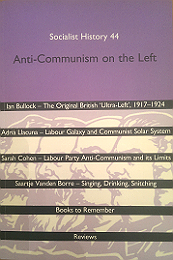
Although 'anti-communism' has generally been associated with the political right, the communist movement in the twentieth century was subject to trenchant, and often cogent, criticism from its rivals on the political left.
In this issue, Ian Bullock examines the divisions which occurred at the time of the CPGB’s foundation between those who clove to the line of the Communist International and the various 'impossibilists' who criticised the party from 'leftist' or 'purist' perspectives. Adrià Llacuna looks at relations between the CPGB and the Labour Party in the 1920s and 1930s from the broader perspective of social-democratic criticisms of communism. Sarah Cohen considers the limits of Labour Party anti-communism through the case of Sam Watson, a miners’ leader and top Labour Party functionary who during the Cold War simultaneously worked against communist influence within the labour movement while maintaining a business-like collaboration with the NUM's communist General Secretary, Arthur Horner.
On a different topic, Saartje Vanden Borre tells the remarkable story of Victor Capart, publican, songwriter, pioneer of socialism in Northern France in the late nineteenth century - and police spy. Despite his betrayal of his comrades, in the end his activities were probably more of an asset to the movement than ever they were to the police.