


Today it is clear that there was never anything inevitable about the forward march of secularism as the companion to modernisation, as many scholars once assumed and despite the secularising tendencies of the nineteenth century, religion remained part of the dominant ideology. Indeed, neither religion nor the state has withered away, as Enlightenment rationalism and Marxist teleology predicted. Rather, the resurgence of religion in global society has heightened awareness of its potency as a political force and re-legitimised it as an object of study.
The articles in this issue of Socialist History show that the religious dimension of history provides fruitful insights, into the 'stuff' of national as well as international politics. In a world in which power remains the key currency, understanding what constitutes religious power is increasingly important. Eric Hobsbawm's dictum regarding the 'supremacy of evidence' is essential in gauging how far religious ideas are independent factors shaping policies and attitudes or whether they are primarily intended to facilitate policy-making motivated first and foremost by strictly secular considerations.
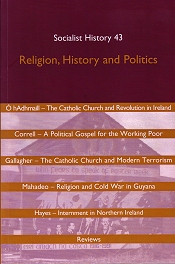
Féilim Ó hAdhmaill traces the continuing influence of the Roman Catholic Church on the island of Ireland. Mark R. Correll looks at attempts by German Protestant pastors, Adolf Stoecker and Cristoph Blumhardt to get their churches to engage with the urban poor in the late nineteenth century. Charles Gallagher considers the question of 'terrorism' in Vatican discourse. Michael Mahadeo shifts the focus to South America and the destructive role played by religious groups and churches in Guyana's turbulent transition to independence. Mark Hayes revisits the story of the internment of more than two thousand suspected nationalist and republican activists in Northern Ireland in the 1970s.