


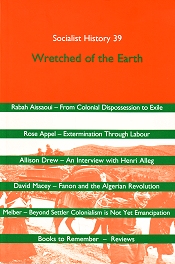
This issue commemorates the Algerian struggle against French colonialism and its war of independence (1954-62), known as the Algerian revolution. Rabah Aissaoui addresses the conditions of Algerian migrant workers in inter-war France, highlighting the racism that permeated the spatial arrangements in which they lived, impeded their social integration into the French working class and reinforced their ties with their home communities in Algeria.
The Second World War intensified racism and oppression in Europe and North Africa. Rose Appel's memoir - introduced by Ronald Kieve - is a graphic and harrowing account of the Nazi persecution and use of the Jews as forced labour. Henri Alleg, who joined the Algerian Communist Party when the struggle against fascism and Nazism was in full swing, discusses his political work during the Algerian anti-colonial struggle. David Macey evaluates the international impact of Frantz Fanon alongside his ambiguous standing in contemporary Algeria, while Henning Melber considers the relevance of Algerian-born Albert Camus for the understanding of violence and non-violence in the South African context. These articles raise important questions about the complexities of anti-colonial resistance, about the ways in which ethnicity, nationalism and racism divide workers and communities, and about the difficulties of developing democracy in post-colonial contexts. These historical struggles are far from resolved. The popular, democratic and anti-authoritarian uprisings now sweeping across the Arab world are part of a long tradition.