


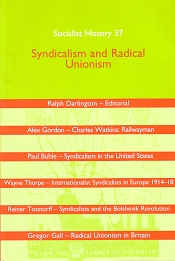
During the first two decades of the twentieth century the ideas of revolutionary syndicalism connected with, and helped to produce, mass workers' movements in a number of different countries across the world. Socialist History 37 explores the issues which this raises from a number of different perspectives.
Alex Gordon's glimpse into the syndicalist railwayman Charles Watkins adds a much needed rank-and-file dimension to the biographical literature on British syndicalism. Paul Buhle offers a panoramic overview of syndicalism in the United States. Wayne Thorpe documents in graphic and detailed fashion the way in which European syndicalists in the First World War raised their voice against the discourse of national defence. Moving into the 1920s, Reiner Tosstorff examines the conflictual nature of the relationship between revolutionary syndicalist organisations and the Bolsheviks and the Comintern. Finally Gregor Gall's focus broadens out from syndicalism per se to the wider historical experience of 'radical' labour unionism in Britain, from the 1880s to the 1970s. Like the issue as a whole, the article brings out both the limits and potential of radical unionism. A wide-ranging introduction is contributed by the editor of the issue, Ralph Darlington.
As well as the usual reviews, the issue also includes two articles on communists in Britain. In his reflections on reading the MI5 files on the poet Randall SwingIer, Andy Croft suggests that the road to Guantanamo Bay may be traced from the 1940s, with the systematic removal of communists from public life and then public memory. It is a passionately argued piece and a fitting supplement to the author's important biography of Swingler. Kevin Morgan's account of wartime communist politics suggests that the evidence of the 1945 General Election can only be explained on the assumption of the radicalisation of a much wider section of Labour opinion.