


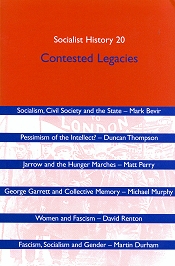
Historians base their claims to insight and authenticity on preserved traces of the past. But this evidence is subject to continuous reinterpretation in the light of new scholarship and evolving contemporary agendas. The articles in this issue represent competing claims to some familiar legacies of the past.
Duncan Thompson analyses the intellectual legacy of the Marxist journal New Left Review. He argues that a critical reflection on this journal's past is essential if it is to engage with the politics of the twenty-first century. Mark Bevir offers a longer perspective on the intellectual legacies of the British left in his article on the relationship between socialism and classical liberalism, and their contribution to shaping civil society and the state.
In a reappraisal of the unemployed demonstrations of the 1930s, Matt Perry argues that the communist-inspired National Hunger March of 1936 had a much greater impact than the better known Jarrow Crusade. Michael Murphy explores the way in which lived experience of the 1930s inspired the writings of unemployed seaman George Garrett, in contrast to the middle-class literary tradition of the decade.
Two further contributions consider the legacy of fascism, in particular its relationship with gender. David Renton argues that fascism is inherently hostile to women's rights, while Martin Durham shows that variations of time and place, as well as divisions within fascism itself, mean that this is not invariably the case.