


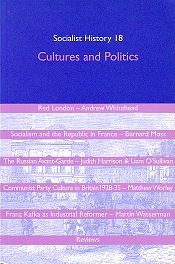
Political cultures and cultural politics link the five main articles in the current issue, which otherwise range widely across both cultural and political boundaries.
Andrew Whitehead and Bernard Moss explore in different contexts the issue of rupture and continuity in radical political culture. Focusing on the radical stronghold of Clerkenwell, Whitehead argues for significant discontinuities between late Victorian radicalism and the emergent British socialist movement. From a French perspective, Bernard Moss presents a rather different argument, tracking the persistence of republican traditions on both the ideology and popular support of the French left even to the present day.
Further contributions focus on the relationship between communism and culture. Judith Harrison and Liam O'Sullivan, in examining the Russian avant-garde in the period 1905-1924, show how a brilliant generation of revolutionary artists, themselves blasphemers and subversives until Tsarism, found little improvement in their lot under Bolshevism. Matthew Worley's focus is on the political culture of British communism in the so-called Third Period, where he argues that political marginality was not incompatible with a rich and vigorously adversarial political culture.
A final article by Martin Wasserman deals with a neglected aspect of the life of Franz Kafka, remembered here not as enigmatic literary genius but as a 'key industrial reformer'.