


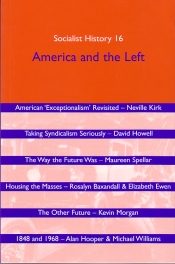
Un-American or anti-American, the left has never had the easiest of relationships with the American dream. However, the contents of the present issue suggest that there has always been more to this relationship than simple antagonism. Issues addressed in a range of contexts include the notion of American exceptionalism; the construction of divergent or contested versions of America and Americanism; and the variety of responses to its dominant readings in both Europe and America itself.
In their articles on syndicalism and Samuel Gompers, David Howell and Neville Kirk insist on the complexity of political commitments that have too often been treated in a facile or reductionist fashion. In the 'taking seriously' of such figures, there is, according to David Howell, a legacy to be recovered that is far from irrelevant to present concerns.
In their account of US housing experiments in the 1920s, Rosalyn Baxandall and Elizabeth Ewen stress the importance of democratic and communitarian aspirations which were never to be fully realised. Focusing on the same period, Kevin Morgan reveals the suspicions that Americanism aroused in much of the British left, and compares this with more positive attitudes evident in Weimar Germany and even Bolshevik Russia.
Rounding off the issue, Alan Hooper and Michael Williams present their wideranging reflections on the revolutions of 1848 and 1968. Among the major intellectual figures discussed, they concentrate especially on Marx, de Tocqueville, Dwight MacDonald and C.L.R. James.